

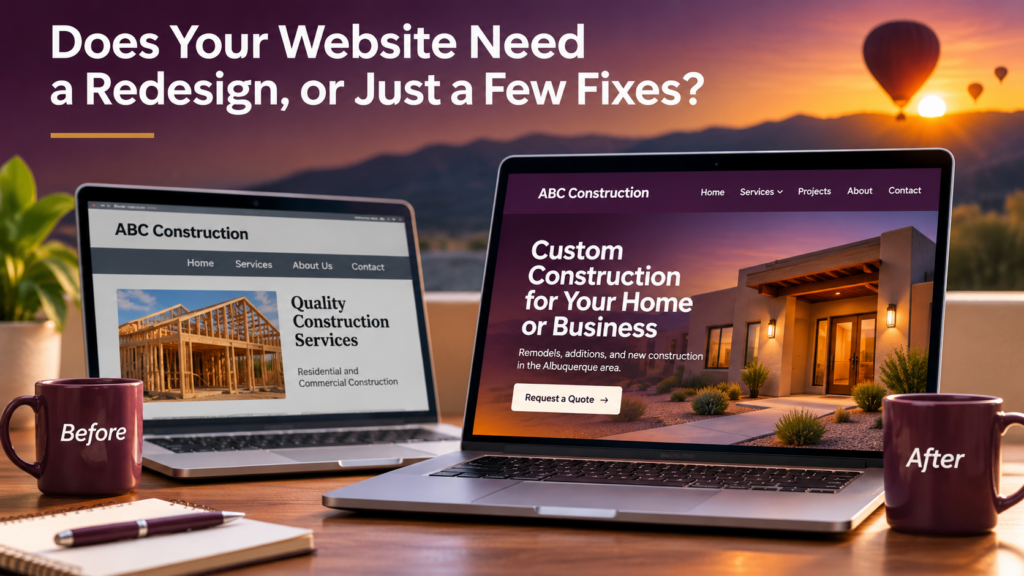
A website can feel outdated without being beyond repair. Maybe the layout looks tired, the mobile menu is awkward, or visitors are finding the site but rarely contacting you. Those problems are worth addressing. They do not automatically mean you need to throw the whole website away.
The better question is: what is actually keeping the site from doing its job?
Sometimes the answer is a focused cleanup. Sometimes the design and content need a broader rethink. And sometimes the platform underneath has become more trouble than it is worth. Here is how I would tell the difference before spending money on a website redesign.
Start with the problem, not the appearance
It is easy to look at a competitor’s new website and decide yours needs a replacement. But a website is more than a visual design. It is also the place where customers learn what you offer, decide whether they trust you, and figure out how to get in touch.
Before changing anything, look at three things:
- Clarity: Can someone understand what you do, who you help, and what to do next within a few seconds?
- Usability: Can they read, navigate, and contact you easily on a phone?
- Performance: Are the important pages getting found, loading reliably, and producing useful inquiries?
A site that looks a little dated but answers those questions well may need fewer changes than you think. A beautiful site that leaves visitors confused may need considerably more work.
When a website refresh is enough
A refresh means improving the website you already have without reworking its entire structure or replacing the underlying system.
It is often the right choice when your site is generally sound but has specific weaknesses. Maybe the homepage needs a clearer headline. Your services may be buried in one long paragraph. The contact button may be hard to find. Or the photography and typography no longer reflect the business.
A focused refresh could include:
- Rewriting the homepage headline and service descriptions.
- Improving mobile spacing, navigation, and button placement.
- Updating photographs, testimonials, and project examples.
- Making contact forms simpler and easier to find.
- Removing outdated pages and fixing broken links.
- Improving page titles, internal links, and basic technical issues.
For example, imagine a contractor whose website already appears for relevant searches, has useful service pages, and brings in occasional calls. The homepage is cluttered and the estimate button is almost invisible on mobile. I would look at the layout and contact path before recommending a complete rebuild.
The point of a refresh is to keep what works and fix what doesn’t. If the main problem is keeping content and software current, ongoing website maintenance may be a better investment than redesigning everything.
When a redesign makes sense
A redesign is more substantial. It changes how the website is presented and organized, even if you keep the same domain, content management system, and many existing URLs.
I would consider a redesign when the problems are connected rather than isolated. Common examples include a confusing menu, inconsistent pages, outdated messaging, and a design that no longer matches the business you run today.
A redesign may be worthwhile when:
- Your business has changed, but the website still describes the old version.
- Several important services have no useful pages of their own.
- Visitors have to work too hard to find pricing, examples, or contact information.
- The site feels like unrelated templates rather than one consistent business.
- Mobile visitors encounter the same problems across most pages.
In those cases, adjusting a few colors or replacing the hero image will not solve the underlying issue. You may need a better page hierarchy, stronger service content, and a consistent design system.
A good redesign should improve the visitor’s experience, not simply make the website look newer.
When a full rebuild may be the better investment
A rebuild is different from a redesign. It addresses the site’s technical foundation, not just the way it looks.
Some WordPress sites accumulate years of unused plugins, competing page builders, theme overrides, broken integrations, and features nobody knows how to maintain. Others depend on an old system that makes even small updates difficult.
A rebuild becomes reasonable when repairing that foundation would cost almost as much as replacing it, or when the current setup cannot reliably support what the business needs.
That does not mean every WordPress site with a few plugins needs to be rebuilt. It means you should understand the condition of the existing site before committing to a bigger project. A maintainable site with a handful of fixable problems deserves a fair assessment.
Protect what is already working for search
One of the easiest mistakes during a redesign is treating the old website as disposable. An existing site may have useful service pages, links from other websites, or search traffic that took time to earn.
Before replacing pages, I would identify which URLs matter, which content still helps visitors, and which pages are already getting impressions or clicks in Google Search Console.
If a page keeps the same purpose, there may be no reason to change its URL at all. If a URL does need to move, it should point to the most relevant replacement using a proper permanent redirect, not send every old address to the homepage. Google explains this in its site migration guidance.
The same principle applies to headings, internal links, page titles, and useful content. Improve them deliberately rather than deleting everything simply because the design is changing.
A redesign cannot guarantee higher Google rankings. It can give you a better foundation for clear content, usability, and ongoing improvement when it is done carefully.
A simple way to decide
Here is the distinction I use:
Choose a refresh when the site is fundamentally sound and the problems are limited to a few pages, messages, or usability issues.
Choose a redesign when the content, navigation, and overall presentation need to work together differently.
Consider a rebuild when the technology underneath is unreliable, unnecessarily complex, or too restrictive to maintain economically.
These are not rigid categories. A project might involve a redesign of the front end while retaining WordPress and much of the original content. Another might need technical cleanup first and only modest visual changes.
What I would review before recommending anything
When someone asks me whether their website needs to be replaced, I would rather look at the existing site than assume the answer.
I would start with the homepage message, main navigation, key service pages, mobile experience, contact flow, and obvious maintenance issues. I would also ask which parts of the site generate business today and what you wish it did better.
That review helps answer practical questions: Is the site hard to use, or just visually dated? Are visitors finding it but not contacting you? Is the underlying WordPress setup stable? Are there pages worth protecting because they already perform well?
Those answers are more useful than a generic quote for a new five-page website.
You may not need to start over
If your existing website is doing some things well, I would want to preserve them. If the site’s structure is working against you, I would say so. And if a rebuild is the sensible long-term choice, I would explain why.
ABQ Finest Web Design is based in Rio Rancho and works with businesses and organizations in the Albuquerque area and throughout the United States. I handle WordPress cleanups, redesigns, custom builds, and ongoing support, with the goal of finding the right amount of work for the problem. You can also see examples of my work.
Get a clear answer before you rebuild.
I can review your existing website and help you decide what is worth keeping, what needs attention, and whether a few focused changes would be enough.